Sunday, March 13, 2011

U.S. to rebid $2.4 billion in Florida rail funds (Reuters)

WASHINGTON (Reuters) ? The Obama administration will rebid nearly $2.4 billion in high-speed rail grants recently rejected by Florida, one of three states to conclude "bullet train" projects are too expensive in a tough economy.

California and several Northeastern states have expressed interest in the money, much of which came from $8 billion in rail grants from the 2009 U.S. economic stimulus package.

"States across the country have been banging down our door for the opportunity to receive additional high-speed rail dollars," Transportation Secretary Ray LaHood said on Friday in announcing his agency would rebid the funds initially awarded to Florida but declined by Governor Rick Scott.

Proposals are due on April 4.

A regional rail authority in Florida not affiliated with the state government is also interested in applying for the funds, according to Florida U.S. Senator Bill Nelson.

Florida had received a small fraction of the money for preliminary work on a proposed east-west line linking Orlando and Tampa.

Wisconsin and Ohio have also declined high-speed rail funds, and New Jersey separately rejected billions in federal funds for a new rail tunnel to New York City.

Florida and the other states said potential cost overruns made the projects unaffordable.

LaHood's decision to rebid the money followed attempts by Florida's congressional delegation and city mayors to try and redirect or otherwise salvage the grant.

The money is considered by rail supporters to be essential for job creation in Florida.

Introducing high-speed trains like those found in Europe and Asia to the United States is President Barack Obama's signature transportation priority. He has proposed to spend $53 billion over six years to further existing projects and launch new ones.

However, leading Republicans in Congress, especially in the House of Representatives, doubt the potential of high-speed rail and are wary of the massive capital investment in an era marked by budget shortfalls for existing priorities.

Stephen Gardner, Amtrak's vice president for policy and development, told a congressional hearing on Friday that high-speed rail will be expensive, take years to build and profits are not assured.

Amtrak is the nation's only provider of long-haul passenger rail service, and its Acela train between Boston, New York and Washington, D.C., is the closest thing to high-speed rail available to U.S. travelers.

John Mica, a Florida Republican who has influence over rail development as chairman of the House Transportation Committee, believes building high-speed service in the heavily traveled Northeast would be worthwhile.

Mica is a strong proponent of private investment, which Gardner said was not "the silver bullet" for success that some believe.

"Not surprisingly, potential private sector participants in high-speed rail service have emphasized that significant public funding is an essential prerequisite" to their involvement, Gardner said.

LaHood said he has secured commitments from 30 overseas and domestic rail manufacturers to locate or expand business in the United States if they receive high-speed rail contracts.

(Editing by Dan Grebler; Editing by Leslie Adler)


Powered By iWebRSS.com

money finance economics precious metals investing in gold

Saturday, March 12, 2011

Couple Charged with $130 Million Fraud

March 11, 2011, 12:05 AM EST

By Joel Rosenblatt

March 11 (Bloomberg) -- A California couple was charged by the U.S. with defrauding an eight-bank lending group led by Bank of America Corp. of about $130 million by exaggerating the financial status of their decorating business.

Thomas Chia Fu, 61, and his wife, Cheri L. Shyu, 48, were arrested at their Newport Coast home by federal authorities, according to an e-mailed statement yesterday by U.S. Attorney Andre Birotte Jr. in Los Angeles. They were indicted on nine counts of bank fraud and face as long as 30 years in prison if convicted, prosecutors said in the statement.

The couple imported home-decorating items from China and obtained a $130 million revolving line of credit from the banks, according to the indictment. They borrowed against the credit line by exaggerating the in-transit inventory and accounts receivable for their company, Anaheim, California-based Galleria USA Inc., according to the filing.

?Had Bank of America and other banks known the true facts, they would not have continued the revolving line of credit and loaned additional funds,? according to the filing.

Dave Wiechert, a lawyer for Shyu, and Steve Katzman, a lawyer for Fu, didn?t return calls seeking comment.

The Fus submitted their allegedly false reports from June 2008 through March 2009, prosecutors said. Bank of America became the lead bank in the lending group around May 2008, and the fraud continued through August 2009, the U.S. said.

Credit Crisis

That spans the height of the credit crisis, when banks were increasing their scrutiny of loans amid a surge in mortgage defaults. Bank of America took $45 billion in U.S. rescue funds. The bank agreed to purchase Merrill Lynch in September 2008 for $50 billion in stock, months after buying Countrywide Financial Corp.

?This is an ongoing investigation so we can?t provide any further details,? Shirley Norton, a spokeswoman for Charlotte, North Carolina-based Bank of America, said in an e-mailed statement. ?We have been cooperating with authorities on this matter and continue to do so. In fact the bank is a victim of this fraud.?

The case is U.S. v. Fu, U.S. District Court, Central District of California.

--With assistance from Hugh Son in New York. Editors: Michael Hytha, Peter Blumberg

To contact the reporter on this story: Joel Rosenblatt in San Francisco at jrosenblatt@bloomberg.net.

To contact the editor responsible for this story: David E. Rovella at drovella@bloomberg.net


Powered By iWebRSS.com

economics precious metals investing in gold investing in silver bullion investing

The countries with the largest gold reserves

Value: $151.3bn

? 3 IMF

Total gold holdings: 2,827.2 tonnes

Value: $125.7bn

The IMF oversees international economic operations of 187 member countries. Reserves remain to stabilise international markets and aid national economies.

? 4 Italy

Total gold holdings: 2,451.8 tonnes

Value: $109bn

? 5 France

Total gold holdings: 2,435.4 tonnes

Value: $108.3bn

? 6 China

Total gold holdings: 1,054.1 tonnes

Value: $46.9bn

? 7 Switzerland

Total gold holdings: 1,040.1 tonnes

Value: $46.3bn

? 8 Russia

Total gold holdings: 784.1 tonnes

Value: $34.9bn

? 9 Japan

Total gold holdings: 765.2 tonnes

Value: $34bn

? 10 Netherlands

Total gold holdings: 612.5 tonnes

Value: $27.2bn

Discover the top-selling ISAs and get 0% commission when you order online with Telegraph ISA-fund Supermarket.


Powered By iWebRSS.com

investing in silver bullion investing stocks markets investing

Capital One Shows Big Credit Card Sign-Up Rewards Are Back

Capital One bank signWe've written about Capital One's Venture card before because it offers attractive rewards for frequent travelers. If you've been considering applying for one of these cards, now's the time: Capital One is rolling out a new promotion in which it will match up to 100,000 frequent flier miles accrued on another card.

Capital One uses a simple formula to calculate the cash value of miles: Divide by 100. In other words, 50,000 miles equals $500; 100,000 miles is $1,000. According to CBS MoneyWatch, the promotion runs until May 13th or until the company gives away a billion miles.

This is a terrific example of how issuers are aggressively courting new customers, a trend most analysts pronounced dead after the credit crisis hit. "I definitely think all the talk of demise of aggressive reward programs in light of new Congressional regulation was overblown," says Doug Miller, senior analyst for banking and cards at financial market research firm Corporate Insight. "I don't want to say they cried wolf, but it seemed like that at the time, they were making a bigger deal out of it than it would actually be," Miller tells WalletPop. "If you want new clients you still need to be aggressive."

Miller explains how issuers can afford to dole out the the lavish perks: Card companies are cutting back or outright eliminating 0% balance transfer offers, and they're raising the initial APR rates, even for customers with excellent credit. In addition, cards with annual fees (like the Venture) tend to be marketed more aggressively, Miller says. "Issuers will be more aggressive and offer more perks for cards that carry an annual fee."


The Venture card offer also reflects a shift away from single-airline cards toward generic travel -reward cards that give the user flexibility to travel on any airline. For customers that only fly on a single airline, Miller says traditional frequent-flier cards, which let you earn miles that can be cashed in for a future trip, offer value. On the other hand, "A card like the Venture is good if you mix and match airlines," he tells WalletPop. "If you want to go for simplicity and ease, the self-branded cards can't be beat," Miller says. "That's going to be the most transparent."

The other thing for consumers to keep in mind is to be sure and read the fine print and make sure you understand all the details of a card offer before you sign up for it, Miller says. In the case of the Venture card offer, there are three caveats: You need to charge $1,000 on the card within the first three months, you have to have what Capital One terms "excellent" credit, and the card comes with a $59 annual fee, although that's waived for the first year.


Powered By iWebRSS.com

markets investing money finance economics

Toyota, other carmakers close quake-hit plants (Reuters)

TOKYO (Reuters) ? Toyota Motor Co (7203.T) said it has halted production at two factories with combined annual capacity of 420,000 small cars built mainly for overseas markets, after a massive earthquake hit Japan the previous day.

Toyota, Japan's biggest carmaker, said it had not decided when it will restart either facility.

Managers at the plants, one in Iwate prefecture and the other in Miyagi prefecture, the areas hardest hit by Friday's quake and subsequent tsunami, has evacuated personnel, so the current state of the facilities is unknown, Toyota said.

Nissan Motor (7201.T) said that it had halted output at four plants in northeast Japan and close to Tokyo and suspended work at an operation center. The factories will stay idle Sunday and Monday, it said.

Staff at locations close to the coast were evacuated, while employees at other facilities were urged to remain on site. Two workers at a plant in Tochigi prefecture were slightly injured by the quake, Nissan said.

Honda Motor (7267.T), Japan's No. 3 carmaker, said four of its domestic plants and a research and development center will stayed shuttered on Monday.

(Reporting by Kentaro Sugiyama; Writing by Tim Kelly)


Powered By iWebRSS.com

economics precious metals investing in gold investing in silver bullion investing

Friday, March 11, 2011

Job openings, rate fell in January (Reuters)

WASHINGTON (Reuters) ? U.S. job openings slipped in January, as did the job openings rate, government data showed on Friday.

Job openings, a measure of labor demand, fell 161,000 to a seasonally adjusted 2.76 million for the month, the Labor Department said in its monthly Job Openings and Labor Turnover Survey. December job openings were downwardly revised to 2.92 million.

The job openings number in January was 361,000 openings higher than the level a year earlier, but it was still well below the 4.4 million openings at the start of the recession in December 2007, the Labor Department said.

In January, the job openings rate -- a gauge of how many jobs were still open at the end of the month -- fell to 2.1 percent from 2.2 percent in December.

The rate of new hires also slipped in January, to 2.8 percent from an upwardly revised 3.0 percent in December. The construction hires rate showed the biggest decline, from 6.5 percent in December to 4.5 percent in January.

The separations rate -- or job turnover, including voluntary and involuntary separations -- fell slightly to 2.7 percent in January from 2.9 percent, the Labor Department said.

The report showed 3.71 million people hired in January, down from 3.91 million in December and well below the 5 million monthly hires at the start of the recession.

The rate of people who quit their jobs in January, which often is seen as a measure of workers' willingness or ability to change jobs, fell to 1.4 percent for private employees but was little changed for nonfarm workers, at 1.3 percent, and government employees, at 0.5 percent, the report said.

Although still low, the number of quits was higher than in January 2010 for nonfarm and private employees, the Labor Department said.

The layoffs and discharges rate was essentially unchanged in January for total nonfarm and total private payrolls, but the number of layoffs by nonfarm employers reached a series low of 1.5 million during the month, the report said.

(Reporting by Emily Stephenson; Editing by Andrea Ricci)


Powered By iWebRSS.com

precious metals investing in gold investing in silver bullion investing stocks

It May Be OK to Use Regular Gas Instead of Premium

Can you use regular gas instead of premium?Do you drive a relatively new car that requires premium gasoline? Do you seethe every time you fill up, watching that extra dime or more flow into your tank with each gallon? According to a new report from Edmunds.com, you may be able to burn regular gas in your premium car.

Philip Reed, Senior Consumer Advice Editor, and Jason Kavanagh, Edmund's Engineering Editor, recently wrote that the technology behind today's engines has actually reached the point that many of the vehicles that manufacturers suggest be fueled with premium gas can actually function quite well on regular. Thanks to the electronics in the ignition system, the engine can compensate for the lower octane.

The company has compiled a list of the cars and trucks made over the past four model years that separate those for which premium is required (over 1,500 makes and models) and those in which premium is recommended (over 700 makes and models). Those in which premium is recommended are candidates to run on regular fuel. In other words, you have about a one in three chance of being able to switch to regular without harming your vehicle.

What difference in performance should you expect? According to the two, you might not accelerate quite as briskly, but shouldn't experience engine knock, the sign that the octane is not up to snuff.

For more gas-saving tips, read How to Save on Gas as Prices at the Pump Climb.


Powered By iWebRSS.com

stocks markets investing money finance

Telefonica Could Ring Up Big Profits for Investors

There's no denying that investors have racked up huge gains over the last two years. March 9, 2011 marked the two year anniversary of the S&P 500 bottom, from which the index has nearly doubled. This massive surge in stock prices has had me looking harder than ever for value. Don't get me wrong, I'm still fairly optimistic on the stock market, just not as optimistic as I was a year ago.

My recent search for value has me looking at companies that trade at low price/owner earnings ratios. Telefonica (TEF) is a company that keeps coming onto my "value radar". I recently listed the stock in an article "8 Tech Stocks With a Price to Owner Earnings Ratio Under 10".

Telefonica is the largest telecom in Spain. I don't have to remind you that Spain has been an area of concern for Europe's debt woes. This is one reason Telefonica has become so inexpensive. Shares are only up 4% over the last twelve months.

Telefonica has 287 million customers, of which 220 million are mobile subscribers. The company recently reported earnings of $2.99 per share versus estimates of $2.47 per share for the year ending 2010. Revenues were up 7.1% year over year.

The excitement for Telefonica isn't in Spain though. The company reported that Latin America now accounts for 43% of sales. According to a recent article in Barron's, Latin America subscribers account for 150 million of the 220 million total wireless subscribers. It isn't hard to imagine that the company's future growth will come from booming Latin America. It's estimated that less than 30% of revenue will come from Spain in 2012.

Telefonica trades at a reasonable 9.6 times 2011 earnings. The company has grown earnings at an annualized rate of more than 20% over the last five years. Revenues have also been strong, growing at an annualized rate of 10% over the same period. Telefonica trades at a price/owner earnings ratio of 8.18, making it a true value stock (for a detailed description of price to owner earnings, read this article). The company has a large but manageable debt load of $70 billion. Below are the valuation metrics for Telefonica.

Telefonica

Metric

TEF

Market Cap

$114 B

Recent Price

$25.25

Forward P/E

9.63

Dividend Yield

7.09%

5 Year Div. Growth Rate

39.10%

Payout Ratio

46.00%

Price/Book

3.4

Price/Cash Flow

4.99

Price/Earnings Growth

1.1

Price/Owner Earnings

8.18

Return on Equity

N/A

Debt/Equity

N/A

Revenue TTM

$81.4 B

Operating Cash Flow FYE

$22.3 B

Capex FYE

$11.97 B

Capex/Cash Flow FYE

0.54

5 Year Rev. Growth Rate

10.20%

5 Year Cash Flow Growth Rate

11.20%

5 Year Earnings Growth Rate

20.50%

Net Profit Margin

13.53%

Current Assets

$29.73 B

Return on Assets

6.96%

Long-Term Debt

$70.03 B

As if the fair valuations weren't enough, Telefonica has a dividend yield above 7%. The company recently raised the dividend 14%, making its 9th consecutive annual increase. The payout ratio stands at only 46%.

As concerns over Europe will continue to surface in headlines, it will take time for investors to realize that the news isn't all that bad for Telefonica. Investors may have to be patient for shares to rise substantially. In this case though, patience will pay you 7% a year. It appears Telefonica could ring up big gains for investors.

Disclosure: I have no positions in any stocks mentioned, but may initiate a long position in TEF over the next 72 hours.


Powered By iWebRSS.com

investing money finance economics precious metals

Moody's downgrades Spain

"From this point on, whoever says we need a different amount should say in which entity," she added.

The finance minister agreed however that more should be done to control spending by semi-autonomous regional governments.

"Yes, we do have to make greater efforts to control the [public] deficit and this has to be done in particular by the regional governments under our supervision," she said.

The cut in the rating - to Aa2 from Aa1 - drove the euro to session lows against the dollar, and the premium investors charge for Spanish 10-year debt instead of German Bunds widened nine basis points on the day to 232 bps.

"This is clearly negative. I'm not sure up to what point, but it will certainly impact the banks. Obviously the direct consequence is that it will be harder and more expensive [for banks] to access financing," said Juan Rodriguez Rey, an analyst at Banco Sabadell.

Moody's also noted that nine of the country's 17 autonomous regions breached budget deficit targets.

"This casts doubts over the ability of the central government to exercise sufficient control over the regions to ensure compliance with deficit targets," it said.


Powered By iWebRSS.com

investing in gold investing in silver bullion investing stocks markets

Thursday, March 10, 2011

A gold medal this year, an also-ran the next

Such behaviour is especially worth remembering at this time of year, when fund management companies are promoting their wares for the Isa season. True, adverts no longer scream performance, performance, performance, but for most investors it is the hard return on their cash that counts. Smoothing the ride and protecting the downside don't seem to count for too much.

This explains why the most popular funds tend to be the ones that have had a decent trot recently and the ones that aren't are those funds that have disappointed. Unfortunately, investors often get their timing all wrong.

Take a look at the best Isa sellers of 2006. They included several property funds such as Aberdeen Property Shares - investors who bought five years ago would still be sitting on a loss of 40pc. New Star Property was another bumper seller thanks to an aggressive marketing campaign. Of course, New Star is no more, but the fund is still around in the form of Henderson Property and savers have a long way to go to make a bean.

Jupiter Emerging Europe is another popular fund of late to have slipped. If you had bought it three years ago you would be 7pc down. Other funds that have struggled to justify their sales include Allianz BRIC ? down 1.4pc over three years ? and JPM Cautious Total Return, which is in the bottom 25pc of funds in its sector over one and three years.

Even Britain's biggest fund, Invesco Perpetual Income, managed by Neil Woodford, has lagged its peers over the past three years.

These observations are backed up by a study from the Cass Business School and Barclays Wealth. The research found that timing decisions by private investors since 1992 had cost them an average of 1.2 percentage points a year because they had chased performance. The moral of the story is to ask yourself why you are investing in a fund in the first place ? and if it's only because of stellar returns already achieved, think again.

If it is an untried and untested fund promising the earth, proceed with caution. Jupiter Absolute Return raked in hundreds of millions of pounds in a matter of months a year or so ago, which was down to the manager's reputation ? yet the fund is down by 1.4pc over the year and is sitting in the bottom quartile.

Perhaps the saving grace for this year is that investors are not all chasing one fund or type of fund. A look at the best sellers across fund supermarkets shows that the most popular Isas are a mixed bunch: there are emerging market funds, income funds, corporate bond funds, cash funds and even property funds among the top 10 best sellers. The only surprise is that there doesn't appear to be a gold fund among them.

Discover the top-selling ISAs and get 0% commission when you order online with Telegraph ISA-fund Supermarket.


Powered By iWebRSS.com

markets investing money finance economics

Stanley Recalls Door Locksets Because Latches Can Fail

stanley door locks locksetsStanley Security Solutions Inc. recalled about 63,100 door locksets because the latches can fail and the door can't be opened from the inside, creating a risk if a consumer can't get out in case of an emergency, the U.S. Consumer Product Safety Commission said.

The Indianapolis company received five reports of the latches failing, including one entrapment. So far, no one has reported getting hurt. Stanley products are carried in stores including The Home Depot.

Included in the recall are 6K and 7KC series medium duty locksets. The sets have either a brass or stainless steel finish and may have the word "best" embossed on the key core. The locksets were made in Taiwan and were sold nationwide from April 2010 through January 2011 for between about $80 and $260.

Consumers can call Stanley Security Solutionstanley door locksets lockss at (888) 312-8875 weekdays between 8 a.m. and 8 p.m. Eastern Time to schedule an appointment to have the latches replaced for free.

In December, First Years American Red Cross recalled cabinet locks meant to keep children out of cabinets with hazards because they could break.

Become a fan of Consumer Ally on Facebook.


Powered By iWebRSS.com

bullion investing stocks markets investing money

Prudent Yield Hog Focus: Two Harbors Investment, Young REIT With a 14.2% Yield

Two Harbors Investment Corp. (TWO) is the highest-yielding stock in the more aggressive ?pushing-the-envelope? version of the StockScreen123 Prudent Yield Hog model I wrote about on March 3.

Brace yourself. With a 14.2% yield in this day and age, you have to expect something way out of the ordinary. I?ll tell you up front, not every prudent-yield-hog situation is going to look like this one, but I figure you?d like to get the lowdown on a 14.2% yield sooner rather than later. So here goes:

This is a new firm, launched in 2009. It invests in mortgage-related securities, and management plans to make sure its investments and dividend policy conform to REIT requirements.

  • Mortgage-related securities constitute the highest-risk REIT sub-segment, the one at the epicenter of the global financial crisis. So this line of business is about as comforting as driving a gasoline tank truck through a forest fire and should, in and of itself, push the yield up toward the top of any yield-hog universe. But in this case, there?s more . . .
  • The firm is very new, having only a one-year track record as a publicly-traded entity.
  • The firm came public via the reverse takeover method that has become so famous, or infamous if you prefer, as a result of many Chinese businesses that chose this way to get access to the U.S. equity market. (Speaking for myself, I?m not down on the process, but many others are and given the dynamics of supply and demand, the trading choices of the majority are going to make themselves felt in stock price levels, and in cases like this, yield.)

That was quick. We see can easily see what the risks are, why Mr. Market is giving about ten percentage points worth of yield above and beyond what we generally see today among REITs, and even a few points above what we typically see for higher-risk mortgage REITs.

Actually, did you notice above, how many extra words I used to refer to this entity as a REIT? There was a reason for that. Legalistically, this is, in fact, a REIT. But for all practical purposes, you can think of it as a hedge fund that emphasizes relative value in the distressed mortgage-securities sector.

I don?t use the phrase ?hedge fund? lightly. The key executives, here, including the two co-Chief Investment Officers, come from a hedge fund firm known as Pine River, which had more than $3.4 billion under management as of late 2010, and a specialty in mortgage securities. The Two Harbors loan portfolio is managed by a Pine Rivers subsidiary set up for that purpose. So a stake in this REIT can be seen as the functional equivalent of an investment in a hedge fund (without the hedge-fund fee structure).

The investment personnel here are Wall Street veterans who have been investors and traders in fixed income in general and mortgage-backed securities in particular. It?s easy for armchair gurus to preach against a bunch of guys who seem to have had their hands on or near the controls as the market careened downward. But if we?re going to pursue yield, we?ll need to check our judgmental tendencies at the door. The hard-boiled view, the one we?ll need to adopt, recognizes that booms and busts happen all the time in all kinds of markets and that when busts occur, it can be a heck of a lot more profitable to grab opportunities rather than to point fingers.

In pursuing opportunities, TWO takes a holistic view of the mortgage-backed market. It goes wherever is believes the values are, whether in agency securities or non-agency, fixed rate or adjustable, derivatives, etc. It uses a disciplined asset-selection approach in an effort to balance interest-rate risk, credit risk, and prepayment tendencies.

Data released by TWO in the 2010 fourth quarter shows the following:

  • The Leverage ratio (defined by TWO as borrowings to fund purchases of residential mortgage-backed securities divided by equity) was 3.3 as of 9/30/10, versus a peer average of 5.6 (TWO?s leverage dropped to 2.5 by December 31st)
  • For every 1,000 basis point change in interest rates, TWO estimates its 9/30/10 equity value would rise or fall by 4.5%, (2.1% by December 31st) versus a 13.9% peer average, thus indicating considerably lower interest-rate exposure
  • At 9/30/10, TWO estimates the prepayment rate of the mortgages upon which its portfolio is based at 9.7% (8.0% by December 31st), versus a peer average of 21.9%

The yield on TWO?s actual portfolio was 5.8% in the fourth quarter of 2010 (3.8% from agency securities and 11.4% from non-agency securities). Obviously, that?s not going to all be passed on to REIT shareholders penny for penny; there are REIT expenses. But it should give you some idea more or less of what TWO?s yield could look like if not for the risk-premium that pushes its stock down.

In its first year of operation, TWO has shown itself to let the dividend reflect available funds: the payouts for 2010 were $0.36 for the first quarter, $0.33 for the second, $0.39 for the third, and $0.40 for the fourth. If we assume the $0.40 quarterly payout persists in 2011, this would suggest a yield of 14.2% on the stock.

That?s not a crazy assumption. Remember, the yield on TWO?s actual portfolio is 5.8%, a number that is not outrageously eye-catching. As noted, the huge yield on TWO stock comes mainly from the fact that investors haven?t, to date, been willing to pay up for the dividend stream, even relative to what we see with depressed prices for other mortgage REITs.

I just want to make one more observation about the impact of the short history on the rank used in the Prudent Yield Hog model. It has a growth component. Some factors are distorted upward by super-high growth rates as revenues etc. go from near-zero to a normal level. More items are distorted lower as the short history causes TWO?s rank to be punished by NA (Not Available) scores for other growth factors. Note, though, that, if I were to completely eliminate the growth part of the model, TWO would still rank in the mid-80s, way above the 40 threshold needed to pass muster.

This is something of an idiosyncratic investment idea, but shareholders are well compensated in the form of a very high yield (a yield high enough to accommodate some payments below $0.40 in the year ahead) for taking an edgy position that?s one of 15 in a model that gets refreshed every three months.

APPENDIX

The Prudent Yield Hog model, created on StockScreen123 and introduced in a 3/1/11 Seeking Alpha article, is based on the notion that income-seekers can achieve satisfactory returns by reaching for the highest possible yields if they work with a list that has been pre-qualified to eliminate companies that bear the greatest risk of dividend cut or elimination.

It uses a screen that contains the following rules:

  • Basic Universe Definitions

o Eliminate OTC stocks, stocks trading below $5, stocks with market capitalization below $250 million, ADRs and companies classified as Miscellaneous Financial Services (most of which are closed-end mutual funds)

o Daily volume over the past 60 days must have averaged at least 50,000 shares

  • Yield must be equal to or greater than 2/3 of the rate on the 10-year Treasury
  • Yield may not exceed 5 times the rate on the 10-year Treasury
  • For this pushing-the-envelope version of the model, the stock must rate 40 or better on a scale of zero to 100 under a ranking system designed to evaluate high-yielding income stocks; under the default version, it would have to rate at least 60

Here?s a summary of the ranking system referred to in the last screening rule:

  • Growth Profile (one third of the score)
  • o Dividend growth (60% of sub-category)

    o EPS growth (30%)

    o Sales growth (10%)

  • Dividend Security (one third of the score)

o Trailing 12 month dividend payout ratio (lower is better) sorted relative to industry peers

  • Investor Sentiment (one third of the score)

o Price signals (30% of sub-category)

o Technical Signals (30%)

o Investor Comfort (40%)

For further details, click here.

From the list of passing companies (i.e., those that have been successfully pre-qualified), select the 15 highest-yielding stocks.

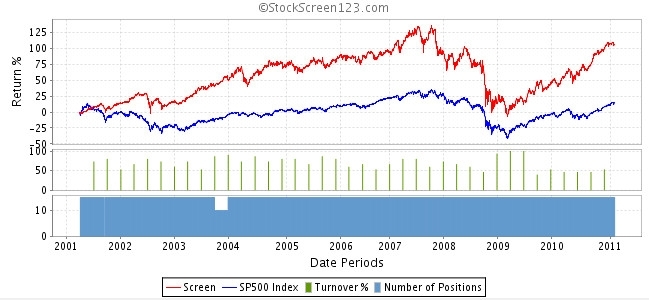
Figure A-1 (click to enlarge) shows backtested price performance of the strategy from 3/31/01 ? 2/28/11 assuming the model is re-run and the list refreshed every three months.

Figure A-1

That?s price performance only. The model faltered during the financial crisis of 2008, as did most other strategies. But the overall start-to-finish capital gain was 106.7%; or 7.6% annualized, which would be added to the yield, which was often in the neighborhood of 9%.

Disclosure: I have no positions in any stocks mentioned, but may initiate a long position in TWO over the next 72 hours.


Powered By iWebRSS.com

stocks markets investing money finance

Illinois border city sees tourist gold in Wisconsin standoff (Reuters)

ROCKFORD, Ill (Reuters) ? Forbes magazine recently dubbed this industrial city about 60 miles west of Chicago one of the worst places to live in the United States, citing its high crime and jobless rates.

So when a bitter political fight 60 miles north in Madison, Wisconsin prompted 14 state Senators to flee across the border and briefly hide out in Rockford, city boosters sensed an opportunity to burnish their town's image, badly maligned last year when Forbes called Rockford one of the 20 Most Miserable Places in America.

Cue the Rockford Area Convention and Visitors Bureau latest campaign, a tongue-in-check Internet-focused push that extols the city as a place to flee no matter who you're trying to get away from -- whether it's your boss, your spouse or your state's newly elected governor.

The campaign, titled Hide Away in Rockford http://www.hideawayinrockford.com/, relies heavily on social media sites like YouTube and Twitter and includes two short videos that highlight the city's restaurants and other attractions.

Both videos feature cameos by Rick Nielsen, the bow-tie- and cardigan-wearing lead guitarist of the rock band Cheap Trick -- perhaps Rockford's most famous living native.

"I've been hiding out here for 40-some, 50 -- I can't even tell you how many years," Nielsen says in the first video, which has already had 100,000 hits on YouTube.

The second video follows the adventures of two fictitious Wisconsin State Troopers dispatched to round up the missing Senators. The two have so much fun in the city that they stop looking, get "Hide Away in Rockford" tattoos and never go home.

Rockford has also reached out to legislators on both sides of the aisle in Madison, as well Scott Walker, Wisconsin's new Republican governor, and offered to host a border summit for the lawmakers, who have fallen out over Walker's plan to strip public employees of most of their union rights.

In an effort to delay passage of the plan, 14 Democratic state Senators fled to Illinois three weeks ago to deny Walker's 19 Republican allies in the chamber the quorum they need to enact the proposal.

Several of them stopped overnight in Rockford and might have stayed here but were outed by Tea Party activists.

"Rockford's location between Madison and Chicago makes it the perfect 'middle ground' for such a summit -- something that has eluded Wisconsin lawmakers of late," the invite says.

John Groh, head of the city's visitors bureau, insists he's not taking sides in the Wisconsin battle, which has triggered protests in Madison that have drawn tens of thousands of demonstrators and triggered more than a dozen recall campaigns across the state targeting both Walker backers and opponents.

"I've consistently said that we're not trying to make a political statement here," Groh said.

"The situation in Madison is serious and significant not only for Wisconsin, its public workers and their economy but for the nation as you see this playing out in other states as well. But what we're just trying to say is that even in life's most tense moments, it's important to push the pause button and get away."

(Editing by Jerry Norton)


Powered By iWebRSS.com

bullion investing stocks markets investing money

Wednesday, March 9, 2011

Summary Box: Bull market hits two with a dip (AP)

TWO-YEAR MARK: The fastest bull market since the 1950s hit its two-year mark with a slight dip. Over the last two years, the S&P 500 has had a total return of 102 percent, including dividends.

OIL STILL HIGH: Oil prices hovered around $104 a barrel, continuing a three-week run that has economists worried that higher transportation costs could undermine the economic recovery.

THE INDEXES: The Dow Jones industrial average fell 1.29 to 12,213.09. The S&P 500 fell 1.80 to 1,320.02. The Nasdaq composite lost 14.05 to 2,751.72.


Powered By iWebRSS.com

finance economics precious metals investing in gold investing in silver

Aegean Marine: Fueling the Global Shipping Fleet

Aegean Marine Petroleum (ANW) offers an interesting twist on the shipping sector. The big story in shipping for several quarters has been the looming supply of new ships ordered during better economic times prior to the credit crisis. The three commercial freight sectors of dry bulk, containers and tankers are all suffering from depressed daily rates as fleet capacity continues to grow faster than demand. We have selective investments in two companies that we believe are well managed, have low levels of debt and trade at a substantial discount to tangible value - they are Overseas Shipholding (OSG) and Euroseas (ESEA) - but a pickup in rates does not appear imminent.

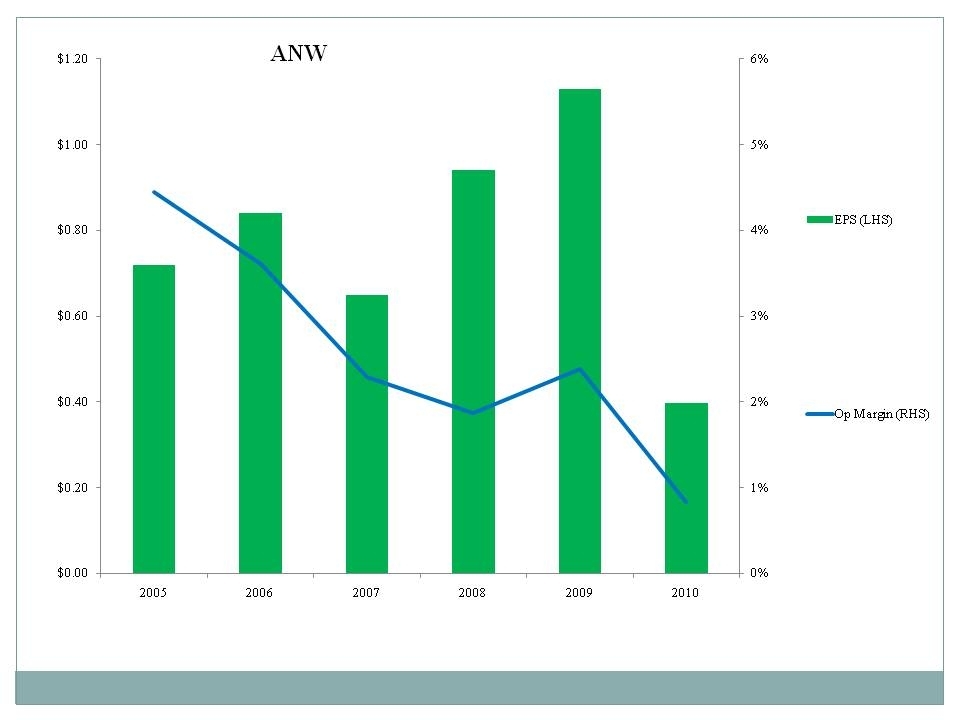
ANW provides bunker fuel to the shipping industry. We liked the complimentary business model ? at a time when fleet capacity is expanding, providing fuel looks analogous to selling gold miners pick axes. There does not appear to be a large supply of refueling ships on the horizon, so the outlook for this segment of the industry is somewhat more promising. However, ANW?s stock has been weak recently, which caused us to take a closer look. Its recent 4Q10 earnings were disappointing (in fact the company pre-announced, the results being so different from expectations). The company buys bunker fuel and sells it on for a slim margin, so its key metrics include the margins at which it operates. The pricing pressure customers are experiencing has been passed through to ANW, and as a result its operating margins and profit have suffered. Its gross spread per metric ton of marine fuel sold fell from $28 in 2009 to $21 last year. The company has responded by transferring ships from more competitive markets (such as Singapore) to others where it can operate more profitably.

The question is whether the depressed margins they have been experiencing represent a temporary condition, or will become a permanent feature of the business model. Because the glut of new capacity in shipping doesn?t apply in the same way to the refueling fleet, we think current valuation represents an attractive investment opportunity.

The company has relatively low debt, and is trading at a discount to tangible book value (though that is true of many shipping stocks). Revenues are expected to reach $6.5 billion in 2011, up 30% from 2010. A 1% increase in operating margin to 1.8% would generate EPS of $2.10. We won?t know for another quarter or two if the margin pressure will abate somewhat, but we think at current levels the stock represents an attractive risk/reward.

Click to enlarge

Disclosure: I am long OSG, ESEA, ANW.


Powered By iWebRSS.com

stocks markets investing money finance