Wednesday, March 9, 2011

Immersion Corporation Earnings Preview

Immersion (IMMR) will be reporting Q4 earnings on tomorrow, March 10.

In the latest conference call, the company guided for revenues to be in the range of $5.8 million to $6.3 million for the fourth quarter. Consensus is for revenues of $ 6.24 million, at the high end of Immersion?s forecast. It should be noted that there are only a few analysts following the company, but their estimates seem to be very similar. All analysts expect the company to deliver a small loss, between a negative ($0.05) and ($0.06) per share.

The company expects to achieve positive adjusted EBITDA for full year 2010.

We expect the company to slightly exceed revenues of $6.3 million in the quarter, as royalties from some segments like mobility, semiconductor, and medical simulators should keep growing; we expect gaming to be flat as well as automotive, whose potential will probably impact Immersion's results only starting from 2012. We'll break down our forecast soon, but first we'd like to comment on some recent company news.

On Tuesday, Immersion announced the release of the MOTIV? SDK 1.0 for Android Developers, which was due for launch in March. The MOTIV effect preview app available on the Android Market provides a quick way for developers to experience and test effects on any Android (GOOG) handset.

Engadget commented that this tool ?helps smartphones move what their makers gave them?:

Interested parties can hit up the source link for the SDK download and start indulging in the haptic dark arts immediately.

Android is probably, today, the most interesting platform for the company, as two of its major partners in mobility, Samsung (SSNLF.PK) and LG (LGERF.PK), are strengthening their smart phone offerings, and now represent a large share of the most advanced and demanding markets.

Here is quick look at the U.S. situation, as reported by Larry Kramer on Seeking Alpha:

Samsung phones still lead the pack of phone manufacturers by a wide distance, with everyone else losing share accept the iPhone which should so significant gains in coming months because it will now, for the first time, be available on multiple networks.

From comScore

In particular, Samsung's strategy of selling several Android-based phones on basically all carriers in the U.S. is giving haptics (and Immersion) a unique possibility to reach almost every potential new smart phone user, building the critical mass that could allow for the next step in the business model (additional revenue streams from mobile phone gaming, etc.).

Immersion's technology is supposed to have been implemented into about 200 million phones by 2010, and we believe that the company will take the opportunity to make a few comments about this achievement at the conference call.

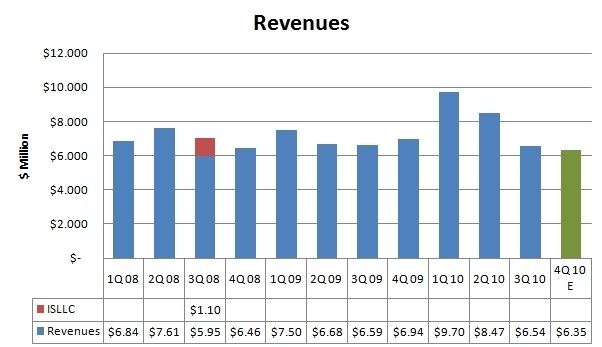
Back to our crystal ball. Here is our Q4 revenues forecast, including past performances:

[Click all to enlarge]


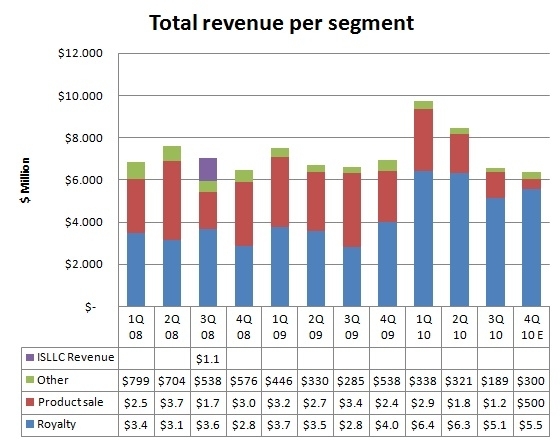
It is always appropriate to remind that the first quarters of 2010 (and previous years) also included revenues from discontinued product sales, so that a more appropriate way to check Immersion's performance is to highlight the different revenue sources:

Here is the royalty-based revenue stream only:
Q1 is traditionally the company's strongest quarter because of seasonality (as partners' Christmas sales are reported in the following quarter), while Q2 2010 was positively impacted by the reconciliation of certain customers reports in the gaming sector. We expect Q4 to show a modest increase from Q3 2010.

Disclosure: I am long IMMR.


Powered By iWebRSS.com

precious metals investing in gold investing in silver bullion investing stocks

Absorbing the Food Shock of 2011

With food prices showing no sign of moderating, companies and governments will need to act aggressively to protect themselves from price spikes

The agricultural price spike of 2008 unleashed riots in more than 30 countries and forced companies into bankruptcy. It lasted five months. The latest rise in commodity prices, which has already helped topple regimes in Tunisia and Egypt, may last many more months, if not years. "If you are not scared, you are not paying attention," says David Nelson, a global strategist in the food and agribusiness research advisory unit of Rabobank in Chicago. "There is no margin for error with these agricultural markets." That prospect has governments and companies around the world searching for ways to profit or insulate themselves from price shocks.

A growing, more prosperous global population is draining stores of grain and meat. Corn inventories?used in food, feed, and fuel?will fall to just 53 days, a 37-year low, before harvest in the northern hemisphere begins, according to the U.S. Agriculture Dept. Soybean stockpiles worldwide may be the lowest in almost 18 years. Tight inventories and a recovering global economy set this rally apart from the abrupt rise and fall in 2008. That's when crude oil led commodities higher in February, and a plunge in food demand amid the recession pulled prices down in July. "This one is different," says Dennis Gartman, an economist and editor of The Gartman Letter, a market tracker. "This is sustainable. We're coming out of global recession, and we're going into global strength."

Deere & Co. (DE), the world's largest farm-equipment maker, is building factories in emerging markets to capitalize on this growing appetite. The Moline (Ill.)-based company in January announced a $100 million investment in India, where Deere will also court small-scale farmers both with a cheaper tractor one-tenth the power of U.S. models and a program that enables them to share equipment. "A farmer on one hectare of land could never afford that tractor," says Chief Executive Officer Samuel Allen. Yet "if you help them mechanize, that helps them go from using an ox to a tractor."

Other companies are lobbying Washington to boost the number of U.S. acres that can be farmed. The Andersons (ANDE), a Maumee (Ohio) grain merchandiser and elevator operator, is calling for the temporary removal of some of the 31.2 million acres set aside by the federal Conservation Reserve Program. The CRP pays farmers to leave land idle as a way of preventing soil erosion and other environmental damage. "We need to have large enough crops where we can stop the decline and start to replenish," says Hal Reed, president of Andersons' grain and ethanol group and chairman of the Washington-based National Grain and Feed Assn. "To do that, there aren't enough acres to be planted."

Once farmers harvest the grain, governments are finding new ways to secure supplies and temper prices. South Korea, where inflation of food and nonalcoholic drinks reached at least a 10-year high of 14.1 percent in October, is setting up a trading firm in Chicago to buy grain. It's one of the steps the country, which will soon be importing nearly all of its corn, is taking to secure food at a reasonable price. The state-run Korea Agro-Fisheries Trade Corp. will team up with private companies to establish the firm. The goal is to handle about 30 percent of South Korea's annual imports by 2020.

To tame food prices after drought damaged crops last year, Ukraine has started to work with Leo Melamed, the chairman emeritus of Chicago-based CME Group (CME), to develop its own wheat futures market. A futures exchange would dampen price surges, since farmers could use it as a hedge to reduce losses when crops fail, giving them confidence to plant more in seasons to come. "Over the long run it smoothes out peaks and valleys," says Melamed, who introduced currency futures in 1972.

Companies that buy grains are also preparing themselves for higher, more volatile prices. Sanderson Farms, the fourth-largest U.S. chicken producer, in February said it would delay plans to build a new processing plant in North Carolina until there is "some visibility" regarding crop prices in 2011. In Sanderson's first fiscal quarter, feed, made up of corn and soybean meal, accounted for 52 percent of the cost of producing chickens. Meat processors want to avoid the fate of Pilgrim's Pride, which was pushed into bankruptcy protection in 2008, partly by high feed costs. Corn and soybean futures traded in Chicago rose 52 percent and 34 percent, respectively, in 2010. "There may be gyrations, wild gyrations, this spring and summer during the planting season, if it's wet or dry," says Sanderson CEO Joe F. Sanderson Jr. "It could just be explosive."

The bottom line: Governments and companies must act aggressively to contain the risk from what is expected to be a long-term rise in food prices.

With Sungwoo Park. Singh is a reporter for Bloomberg News.


Powered By iWebRSS.com

investing in silver bullion investing stocks markets investing

Tuesday, March 8, 2011

Searching for Value on the High Seas

Don't let it get away!

Keep track of the stocks that matter to you.

Help yourself with the Fool's FREE and easy new watchlist service today.

These aren't good times to be an ocean shipper.

The Baltic Dry Index, which measures the rates charged by bulk transporters such as DryShips (Nasdaq: DRYS) and Diana Shipping (NYSE: DSX), has fallen from a peak above 4,000 in May to 1,043 today. It has declined by nearly 60% just in the past three months, and it's taken the share prices of many fleet operators down with it.

The following companies have fallen between 12% and 40% in the past year and are likely to report some pretty ugly numbers in the coming quarters. But if you look past the near future, you may find some considerable long-term value in owning a carefully selected ocean carrier. Most now trade for significantly less than the price of their ships, and many can be had for less than the cash flow they generated over the past three years, which was a depressed environment to begin with. And things just may be on the cusp of turning around.

A new beginning?

Company Name

Market Cap

Price/3-Year Average OCF

Price/Book

Debt/Equity

52-Week % Performance

DryShips $1.5 billion 3.67 0.52 97% (12%)
Diana Shipping $945 million 4.80 0.85 30% (12%)
Navios Maritime (NYSE: NM) $492 million 4.32 0.48 219% (22%)
Genco Shipping (NYSE: GNK) $403 million 1.64 0.37 163% (40%)
Excel Maritime (NYSE: EXM) $378 million 1.93 0.23 70% (19%)
Eagles Bulk Shipping (Nasdaq: EGLE) $256 million 2.46 0.39 174% (18%)
Paragon Shipping (NYSE: PRGN) $161 million 2.09 0.33 72% (30%)

Data from Yahoo! Finance, Morningstar, and author's calculations. As of 1/30/11.

Even as commodities have continued their strong performance, dry bulk shipping has suffered from a confluence of woes. For starters, the worldwide cargo shipping fleet is estimated to grow by 18% this year, and that forecast has sparked fears of oversupply. It also hasn't helped that Australia, a major exporter of iron and coal, has seen its exports hampered by excessive flooding. Analysts have estimated that these floods may eventually cause more than 30 percentage points of decline in the Baltic Dry.

With any luck, these matters will be temporary, and they will shortly blow over. Some observers are expecting a new record in goods shipped this year, and so long as the demand for commodities continues to soar, shippers should work through this eventually.

Granted, there are considerable risks. Investors looking to navigate through these waters should know that high levels of debt are all too common in this industry. Small changes in value therefore have a disproportionate equity effect. It's also difficult in such an environment to keep up with debt payments during prolonged periods of slowdown.

The industry has also become heavily dependent on China. The Chinese consume more than 50% of the world's iron ore and import more than one 150 million tons of coal each year to satisfy their domestic demand. A slowdown in China could very quickly bring with it a drop in shipping demand.

But despite the potential headwinds, one has to get excited about these historically cheap valuations. Many of these businesses trade at only a fraction of their five-year average price-to-book values. Investors believing in the strength of commodities may find that with a little bit of due diligence, an investment in the shipping industry may turn into a profitable adventure.

For related Foolish content:

Keep up with the latest Foolish coverage of shipping stocks, or any other stocks you'd like to follow. Just add the stocks you're interested in to My Watchlist.


Powered By iWebRSS.com

investing in silver bullion investing stocks markets investing

Japan Finds No Link Between Vaccines and Child Deaths

Japan's health ministry said on Tuesday it would continue its suspension of pediatric vaccines made by Pfizer (PFE) and Sanofi-Aventis (SNY), despite finding no direct link between the vaccines and the deaths of four children.

Use of the vaccines, which protect children against bacterial infections that can lead to meningitis and pneumonia, was suspended late last week until a safety panel could meet to examine the cause of the deaths. The panel found no connection between the vaccines and the deaths, but it said further study was needed, Reuters reported. The committee will schedule another meeting to review additional data before making a recommendation on resuming vaccinations, according to Pfizer. The company added that it expects vaccinations will resume soon.

Sanofi-Aventis's ActHIB vaccine protects against haemophilus influenzae type b (Hib), one of the most common causes of bacterial meningitis, an infection of the covering of the brain and spinal cord. Pfizer's Prevnar vaccine (also sold as Prevenar) protects against pneumococcal bacteria that can cause ear infections, meningitis and pneumonia, among other things.

The four children, ranging in age from 3 months to 2 years, were administered Prevnar, and all except one received ActHIB at the same time. In addition, three received other vaccines on the same day. Three of the four children died a day after being immunized. Three of the deaths occurred last week.

Timing of Deaths Was Coincidental

In the U.S., both vaccines are part of the recommended childhood immunization schedule for children under 5 years old, according to the Centers for Disease Control and Prevention, and are widely used. According to Sanofi, more than 130 million doses of its hib vaccine have been distributed in the U.S. since it was licensed in 1993.

"CDC and FDA have become aware that vaccination with [ActHIB and Prevnar] has been temporarily suspended as a precautionary measure in Japan while four death reports are examined," Shelly Burgess, a spokeswoman for the Food and Drug Administration told DailyFinance in an emailed statement.

"To date, physicians assessing vaccine safety at the FDA and CDC have not detected new safety concerns. . .among children vaccinated in the U.S. CDC and FDA will continue to monitor the safety of all vaccines, including [ActHIB and Prevnar] vaccines."

According to Forbes, experts in vaccine research say that in all likelihood, the deaths in Japan were coincidental, and that the Japanese health ministry acted too rashly.

ActHIB, Prevnar Prevent Thousands of Deaths Annually

The companies say they're cooperating with the Japanese government. "Pfizer supports the health ministry's conclusion that there is no evidence of a causal relationship to vaccination in these cases," a Pfizer spokeswoman told DailyFinance in an emailed statement. "Pfizer has also thoroughly and extensively examined these cases and all available data ... and has concluded that Prevenar meets all standards for distribution and use in Japan and in all countries where it is available."

"Sanofi Pasteur is fully collaborating [with the investigation]," a company spokeswoman told DailyFinance in an emailed statement. "No causal relationship has been established between immunizations and these fatalities."

According to Sanofi, since ActHIB's launch in 2008, it has been administered to an estimated 1.5 million people in over 3 million doses in Japan, while Pfizer Japan has distributed more than 2 million doses of Prevnar in that country. Worldwide, more than 200 million doses of ActHIB have been administered to children in over 120 countries, and Pfizer has distributed more than 360 million doses of Prevnar in more than 100 countries.

While vaccines can have rare, and usually mild, side effects, the diseases they prevent can lead to deaths. For example, 5% of children younger than 5 years old who contract pneumococcal meningitis will die of the infection, and others will have long-term problems such as blindness or hearing loss, according to CDC. Before the Hib vaccine, about 20,000 children in the U.S. under 5 years old got severe haemophilus influenzae type b each year, and nearly 1,000 people died from it annually.


Powered By iWebRSS.com

finance economics precious metals investing in gold investing in silver

Good Riddance: Warner Bros. Finally Cuts Off Charlie Sheen

Charlie Sheen, whose illogical rantings have won him legions of followers on Twitter (and caused millions more to simply wonder), was fired today by the producers of his hit CBS (CBS) TV show Two and a Half Men. This is hardly a shock.

Sheen's behavior has been both odd and frightening, especially to women. Warner Bros., a unit of Time Warner (TWX) finally had enough of Sheen's antics. The producers figured that the show's star -- who was reportedly paid nearly $2 million an episode --- was no longer worth the considerable trouble he created. Still, the move is a financial risk.

Broadcasting & Cable estimates that the studio would lose $80 million if it ends the show right now. It's not clear whether that's going to happen since John Stamos reportedly was in talks to join the cast.. The Hollywood Reporter recently wrote that a permanent shutdown of the sitcom "could jeopardize as much as $250 million in domestic syndication revenue for producer Warner Bros. Television and millions more in lost ad revenue for CBS."

"Dangerously Self-Destructive"

But Two and a Half Men was losing gas anyway. Other CBS sitcoms such as Mike and Molly and Big Bang Theory are flat out funnier. Plus, viewers began to realize that it wasn't clear any longer where Sheen ended and his character Charlie Harper began. As TMZ reported, Warner Bros. told Sheen's lawyers that "Your client has been engaged in dangerously self-destructive conduct and appears to be very ill."

The media now will be counting the days -- make that years -- it will take for Sheen to blow through all his money. Judging from his latest interviews, Sheen doesn't appear to be much of a saver. Also, check out the statement he gave to TMZ, which may be his nuttiest yet:

Let's hope Sheen's family can get him the help he needs.

Powered By iWebRSS.com

investing in silver bullion investing stocks markets investing

LVMH bags jeweller Bulgari in $5.2 billion deal (Reuters)

PARIS/MILAN (Reuters) ? French luxury group LVMH (LVMH.PA) is buying Italian peer Bulgari (BULG.MI) for 3.7 billion euros ($5.2 billion), adding luster to its jewelry business and broadening its exposure to emerging markets.

The offer, at a 60 percent premium to Bulgari's average share price over the past month, could herald the return of consolidation in the luxury market, which bounced back from the 2009 slump much faster than analysts expected.

Bulgari will benefit from world No. 1 LVMH's global retail network, improve margins through cost-sharing and help the owner of Louis Vuitton handbags close the gap with bigger watch and jewelry companies Richemont (CFR.VX) and Swatch (UHR.VX).

Analysts said the high price was justified by the savings.

"The high price is probably explained by the fact that there were rival suitors," said fund manager Gerard Moulin from Delubas Asset Management in Paris.

Rival bidders included the Richemont group and PPR (PRTP.PA), sources close to the groups told Reuters on Monday. Both groups declined to comment.

Any acquisition of family-controlled assets usually sees a buyer paying a sizeable premium to convince families to sell.

The deal valued Bulgari on a ratio of enterprise value to sales of about 3 times, compared with other potential takeover candidates Burberry (BRBY.L) on 2.7 times and Tiffany (TIF.N) on 2.3 times, using forward sales estimates.

"This multiple is in line with historic deals in the sector and the recent acquisition of (online luxury fashion retailer) Net-a-porter by Richemont," which was roughly 3 times enterprise value to sales, Deutsche Bank said in a note.

The total value of the deal, including 600 million euros of convertible bonds, was 4.3 billion. It will be paid for with 1.9 billion euros of new LVMH shares and 2.4 billion cash to buy out minority shareholders, financed half with debt and half with LVMH's available cash.

Spearheaded by Arnault, LVMH was built on acquisitions and its brands also include Chaumet and Fred jewelry, Celine and Kenzo fashion, Hennessy cognac and Moet & Chandon champagne.

"Bulgari is one of the best known jewelry brands in the world, with lots of potential to grow on the back of LVMH's global distribution reach and financial muscle," Bernstein luxury analyst Luca Solca said.

The deal will double LVMH's watch and jewelry business to make up 10 percent of its sales and about 6 percent of operating profit, analysts estimated.

Analysts believe the deal could lead rival groups to embark on a fresh consoldation wave, encouraged by the strong sales visibility they are getting from big emerging luxury markets such as China.

Bulgari (BULG.MI), established in 1884, had long been seen as a potential target having weakened its finances by embarking on big store investments when its sales were falling. There was regular speculation Swiss group Swatch could take it over.

The transaction comes after LVMH built up a 20.2 percent stake in smaller rival Hermes (HRMS.PA) which, like Bulgari, is family controlled. That move prompted Hermes to fight back by creating a controlling family holding within the group to block LVMH's advance.

LVMH will buy the family's holding in Bulgari of 50.4 percent of Bulgari by issuing 16.5 million LVMH shares. [ID:nBIA07382] [ID:nBIA07381]. In exchange, the Bulgari family will hold a 3.5 percent stake in LVMH and become the luxury group's second largest family shareholder.

"It is important the quality of the paper that you get and LVMH is high quality paper," Bulgari Chief Executive Francesco Trapani said in a conference call explaining why the jeweller had chosen to do a deal with LVMH.

The French group also will launch a buyout offer for the rest of Bulgari shares at 12.25 euros a share.

NUMBER-TWO SHAREHOLDERS

The Bulgari family will name two representatives to the LVMH board while Trapani will join LVMH's executive committee and run its watches and jewelry activities from the second half.

"This should be a catalyst for possible targets in the sector," a French broker said. "As such, we would (see ...) that as a positive for Burberry Group Plc (BRBY.L) notably." Burberry shares were up 3.6 percent.

However, shares in family-controlled Italian luxury leather goods maker Tod's (TOD.MI) were up more than 6 percent on Monday on the back of speculation it could become the next target.

Tod's founder and chairman Diego Della Valle sits on the board of LVMH and owns a small stake in the French luxury giant.

Bulgari shares closed at percent at 12.07 euros while LVMH closed up 1.2 percent at 112.95 euros. (Additional reporting by Antonella Ciancio in Milan and Silke Koltrowitz in Zurich; Editing by David Cowell)


Powered By iWebRSS.com

stocks markets investing money finance

Monday, March 7, 2011

Asian Stocks Fluctuate as Hitachi Rises, While Chip Shares Drop

March 07, 2011, 9:32 PM EST

By Jonathan Burgos and Norie Kuboyama

March 8 (Bloomberg) -- Asian stocks fluctuated as acquisitions boosted Hitachi Ltd. and Terumo Corp., while chip- related companies fell after Wells Fargo reduced its rating on the semiconductor industry.

Hitachi Ltd. advanced 2.6 percent in Tokyo after agreeing to sell its unit that makes hard-disk drives to Western Digital Corp. Terumo Corp. climbed 2.8 percent in Tokyo after offering to buy a unit from Gambro AB to become the world?s biggest producer of blood-transfusion equipment. Hynix Semiconductor Inc., the world?s No. 2 maker of computer-memory chips, retreated 2.1 percent in Seoul.

The MSCI Asia Pacific Index was little changed at 138.03 as of 11:11 a.m. in Tokyo, with almost five stocks rising for every four that declined. The gauge climbed 1.9 percent last week as better-than-estimated economic data from South Korea to the U.S. bolstered confidence in a global recovery, overcoming concern that Middle East unrest will boost oil prices and slow growth.

?There?s a tug of war going on between an improving U.S. economy on the positive side, and unrest in the Middle East sending oil higher on the negative side,? said Koichi Kurose, chief strategist in Tokyo at Resona Bank Ltd., which oversees about $57 billion in assets. ?Each side is getting stronger.?

Japan?s Nikkei 225 Stock Average climbed 0.4 percent. Australia?s S&P/ASX 200 Index was little changed and South Korea?s Kospi Index rose 0.6 percent. Hong Kong?s Seng Index increased 0.3 percent, and China?s Shanghai Composite Index dropped 0.1 percent.

Chip Shares Fall

Futures on the Standard & Poor?s 500 Index increased 0.2 percent today. The index slid 0.8 percent yesterday in New York as escalating violence in Libya sent oil prices higher and chip companies tumbled after the Wells Fargo rating.

Oil climbed to a 29-month high in New York yesterday as fighting between Libyan rebels and troops loyal to Muammar Qaddafi intensified, reigniting concern that supply disruptions will spread through the Middle East. Crude oil for April delivery increased $1.02 to $105.44 a barrel on the New York Mercantile Exchange, the highest settlement since Sept. 26, 2008.

Semiconductor-related shares sank the most among 24 groups in the S&P 500 yesterday after Wells Fargo cut its industry rating to ?market weight? from ?overweight,? citing the 125 percent gain in the Philadelphia Semiconductor Index over the past two years. The downgrade ?is more an indication of a more moderate though still optimistic view of the sector rather than any active concern about the chip stocks as a group,? Wells Fargo said in a report dated March 7.

The MSCI Asia Pacific Index rose 0.3 percent this year through yesterday, compared with gains of 4.2 percent by the S&P 500 and 1.8 percent by the Stoxx Europe 600 Index. Shares in the Asian benchmark were valued at 13.9 times estimated earnings on average as of the last close, compared with 13.6 times for the S&P 500 and 11.2 times for the Stoxx 600.

--Editors: Nicolas Johnson, John McCluskey.

To contact the reporters on this story: Jonathan Burgos in Singapore at jburgos4@bloomberg.net.; Norie Kuboyama in Tokyo at nkuboyama@bloomberg.net.

To contact the editor responsible for this story: Nick Gentle at ngentle2@bloomberg.net.


Powered By iWebRSS.com

investing in silver bullion investing stocks markets investing

David Cameron: And now to business

Judging by his speech yesterday, Mr Cameron is determined that, this time, it will happen; and he intends to take personal charge to ensure that it does. We shall see. More than that, we shall continue to keep a close watch on what is happening through our own contacts with the business world, who can send their stories to redtape@telegraph.co.uk. As we pointed out on Saturday, the number of regulations coming from Whitehall has been growing, not diminishing, over the past six months at the rate of 30 a day. So, while the Government's rhetoric is certainly to be commended, it is action, not words, that will generate a private sector-led recovery. To that end, the proposed creation of new enterprise zones is welcome. These are the sort of practical measures that will turn fine conference phrases into something tangible.


Powered By iWebRSS.com

investing money finance economics precious metals

Sunday, March 6, 2011

Arsenal title hopes hit by Sunderland stalemate

Arsenal handed the Premier League initiative back to leaders Manchester United on Saturday with a limp performance in a goalless home draw against a Sunderland side who had lost their previous four games.

After Manchester United were beaten by Chelsea in midweek, victory for Arsenal would have put their title destiny in their own hands but they mustered few clear chances despite dominating possession and had to share the points with Sunderland for the second time this season.

With 10 games remaining Manchester United, who play Liverpool at Anfield on Sunday, lead the way with 60 points, three ahead of Arsenal, who they still have to play at the Emirates in May.

Manchester City, who beat bottom club Wigan Athletic 1-0, are third on 53 and five clear of Chelsea who visit Blackpool on Monday. Tottenham Hotspur are fifth on 47.

Wenger was annoyed by two decisions that did not go his side's way, describing them as "absolutely disappointing and unacceptable.

"Unfortunately I've seen some things that are difficult to take but that's part of the game," he told Sky Sports.

"We have to take it on the chin and continue to fight. We had problems finding our fluency, I put it down to the quality of their defending and we missed some offensive players."

Birmingham City, who upset Arsenal to win the League Cup at Wembley six days ago, went down 3-1 at home to relegation rivals West Bromwich Albion and dropped into the bottom three.

West Ham United edged out of the drop zone with a 3-0 home win over Stoke City. Fulham beat Blackburn Rovers 3-2 thanks to a controversial late Bobby Zamora penalty and Ivan Klasnic also scored two minutes from time as Bolton Wanderers beat Aston Villa 3-2 to move above Liverpool into sixth place.

Everton beat Newcastle United 2-1 for their first league win at St James' Park in 11 years.

Barren Spell

Sunderland's barren spell at Arsenal is more than double that, their last league win there coming in 1983, but they will be delighted to have gone home with a point.

With a Champions League trip to Barcelona and an FA Cup quarter-final away to Manchester United coming up next week Arsenal boss Arsene Wenger insisted his team were focused entirely on the job in hand but without injured trio Cesc Fabregas, Robin van Persie and Theo Walcott they lacked spark.

Andrei Arshavin had a goal ruled out for a dubious offside decision and substitute Marouane Chamakh headed against the bar 15 minutes from time but Sunderland went close to snatching an upset win when Danny Welbeck's fierce shot was well saved by Wojciech Szczesny.

Steve Bruce, Sunderland's manager and a veteran of many title run-ins with Manchester United, said Arsenal were feeling the pressure.

"We used to call it the 'tickly bit' when you get down to the last nine or 10 games," he told BBC radio Five. "That's upon them, there's a pressure and an edginess and what happened last week in the cup final doesn't help them."

Manchester City have played two games more than Chelsea and Spurs, their main rivals in the race for Champions League places, so needed to ensure a win over Wigan.

They were gifted their goal when keeper Ali Al Habsi allowed David Silva's tame shot through his hands after 38 minutes.

Wigan defender Antolin Alcaraz hit a post early in the second half but City, without ever looking particularly impressive, eased home in second gear.


Powered By iWebRSS.com

finance economics

Bank of England chief under fire after warning Britain is at risk of another financial crisis

Angela Knight, chief executive, British Bankers' Association, said: "We view the Governor with the highest respect, but in this instance there are a number of points with which we disagree.

"The banking industry recognises that some of its number got it badly wrong during the crisis. Since then the industry has reformed radically.

"We work closely with our customers of all sizes and types and in doing so have created one of the largest financial centres in the world and a great contributor to the British economy. We achieved this together by doing our business well - not by doing it badly.

"We entirely agree that no bank should believe it can fall back on the taxpayer. The changes from top to bottom within the industry have ensured the risks are well controlled, and all banks have put recovery and resolution plans in place to answer the too-big-to-fail question and so safeguard customers and the taxpayer against the remote consequences of any future failure."

In the interview Mr King urges high street banks to take a better, longer term view towards their customers and to stop focusing on the need to ?simply maximise profits next week?.

He accuses them of routinely exploiting their millions of customers. ?If it?s possible [for financial services firms] to make money out of gullible or unsuspecting customers, particularly institutional customers, [they think] that is perfectly acceptable,? he says.

The Governor criticises the ?weight put on the importance and value of takeovers? and raises concerns that companies with good reputations have been ?destroyed? in the search for short-term profits.

Mr King expresses regret for not sounding a louder warning over his concerns before the last banking crisis.

The Governor?s remarks are a warning to George Osborne, the Chancellor, as a government commission considers whether to force high street banks to sell off their investment banking arms.

Mr Osborne is thought to be against such a plan, but Mr King is due to ultimately become responsible for banking regulation and his views are, therefore, critical.

In the interview, the Bank Governor says: ?We allowed a [banking] system to build up which contained the seeds of its own destruction.

?We?ve not yet solved the 'too big to fail? or, as I prefer to call it, the 'too important to fail? problem.

?The concept of being too important to fail should have no place in a market economy.?

When asked whether there could be a repeat of the financial crisis, Mr King says: ?Yes. The problem is still there. The search for yield goes on. Imbalances are beginning to grow again.?

Mr King, who rarely gives interviews, suggests that the culture of short-term profits and bonuses within the banks may ultimately be responsible for the problems.

He says that traditional manufacturing industries have a more ?moral? way of operating.

?They care deeply about their workforce, about their customers and, above all, are proud of their products,? he says. ?[With the banks] there isn?t that sense of longer term relationships.

?There?s a different attitude towards customers. Small and medium firms really notice this: they miss the people they know.?

The Governor adds that good businesses ?keep a clear vision of who their customers are, and are run by people who don?t think they should simply maximise profits next week.? He says that the payment of bonuses is part of this cultural problem. ?Why do banks in general want to pay bonuses?? Mr King asks. ?It?s because they live in a 'too big to fail? world in which the state will bail them out on the downside.?

Over the past 30 years, he says, ?we changed Britain away from a sclerotic economy with inefficiencies and problems in labour relations. Everyone got to the point where we no longer expected government to bail us out.?

He says this changed with the banking crisis. 'But, surprise, surprise, the institutions bailed out were those at the heart of the crisis. Hedge funds were allowed to fail, 3,000 of them have gone, but banks weren?t,? he says.

The comments will embarrass the Chancellor, who recently concluded a deal with the banks under which they would be able to resume the payment of bonuses in return for boosting lending.

Mr King does not back down from recent comments that appeared to back the Government?s strategy for reducing the deficit. Ed Balls, the shadow chancellor, recently accused the Governor of becoming too political.

Mr King said: ?It is inconceivable that the Governor has no view on the size of the deficit and the need to reduce it. It would be a dereliction of duty for me not to warn. You need a credible plan to reduce it, over the lifetime of a Parliament. But it is for ministers, not for me, to say how this should be done.?

In the interview, the Governor gives little clue as to whether an interest rate rise is imminent.

Mr King says there is a ?perfectly reasonable case for doing it now? but he added that increasing rates too soon would be a ?futile gesture?.


Powered By iWebRSS.com

economics precious metals investing in gold investing in silver bullion investing

$200 Oil Is a "Totally Exaggerated" Forecast, Says Energy Analyst Gheit

Crude oil prices hit a 29-month high yesterday, closing above $102 a barrel, as the deadly crisis in Libya continues to spur fears that turmoil in the region will spread.

Prices fell slightly this morning following the news that the Arab League is considering an offer by Venezuelan President Hugo Chavez to mediate a peaceful solution. Still, prices haven't dipped below $100 so far today.

Oppenheimer oil and energy analyst Fidal Gheit unequivocally believes that the uprisings, which have also been seen in Egypt, Tunisia and Bahrain, will spread until authoritarian dictatorships are ousted throughout the Middle East. (See: Saudia Arabia's Regime Wll Fall, Says Analyst)

If that does eventually happen, he expects oil to hit $120 to $130 a barrel -- but not $200 or $300, as some have speculated.� Those calls, he says, are "totally exaggerated and totally irresponsible."

Gheit says oil prices are inflated, but there's no need to worry about supply and demand issues.

?We still have plenty of oil, inventories are high and global demand is not recovering as fast as we had expected,? he tells Henry in the accompanying clip. ?OPEC is sitting on 5 million barrels a day of spare production capacity, which can be released in the next few weeks in the event there is disruption in the region.?


Powered By iWebRSS.com

precious metals investing in gold investing in silver bullion investing stocks

Saturday, March 5, 2011

Glencore fee bonanza may elude Xstrata confidants (Reuters)

LONDON (Reuters) ? Ties to Swiss miner Xstrata (XTA.L) may exclude Deutsche Bank (DBKGn.DE) and JPMorgan (JPM.N) from the $300-$400 million in fees that a listing of Xstrata's part-owner Glencore could yield.

A standoff between Glencore Chief Executive Ivan Glasenberg and Xstrata's Mick Davis -- who has called on JPMorgan's Ian Hannam and Brett Olsher, formerly of Deutsche Bank, for a string of deals -- could force banks to take sides.

The listing may also test the much-vaunted client conflicts policy of Goldman Sachs (GS.N), which helped Anglo American (AAL.L) thwart a bid from Xstrata and is Olsher's new employer.

Conflict of interests are particularly thorny in mining, which is dominated by a handful of huge, acquisitive companies, and has played host to a string of acrimonious bid battles such as BHP Billiton's tilt at Rio and Xstrata's move on Anglo.

Long-time advisers Citigroup (C.N), Morgan Stanley (MS.N) and Credit Suisse (CSGN.VX) will be Glencore's lead banks for any initial public offering (IPO), people familiar with the matter say, while a string of rivals are jockeying for secondary roles.

Glencore (GLEN.UL), the private partnership that is the world's largest commodity trader, briefed equity analysts this week ahead of a possible flotation which Liberum Capital estimates could value it at roughly $60 billion.

A listing is not yet a certainty. Its size, timing, and value are all open questions. But the stakes are indisputably high: a $10 billion listing, for example, could pay $300 to $400 million in fees, Freeman & Co reckons.

"It's a huge bonanza at a time when there's virtually nothing going on," said Philip Keevil, a partner at Compass Advisers. Keevil, a former head of European mergers and acquisitions (M&A) at Citigroup, has advised miners including Anglo American and Rio Tinto (RIO.AX)(RIO.L).

The two firms are intertwined: Glencore owns 34 percent of Xstrata; sold the coal assets that helped create it; markets much of its production; and shares a chairman with the London-listed company.

But while people familiar with the matter say Glasenberg has weighed a merger with Xstrata as an alternative route to the public markets, the idea has been resisted by Davis and Xstrata investors, who wanted a public valuation of Glencore first.

"Xstrata should be concerned not to have its core advisers put offside: You don't want to be in a situation where there's nobody able to advise you, because the likelihood is Xstrata will need independent advice down the road," said Keevil at Compass.

"Global co-ordinators and bookrunners are in a conflict-rich environment, reading board minutes, talking to management, and so on. It would be difficult for one of the senior banks on the Glencore float to turn round and fairly represent Xstrata in any future transaction involving its parent."

Deutsche Bank and JPMorgan are Xstrata's longstanding corporate brokers and have counselled Davis on almost every major deal or fund-raising.

Each has received nearly $240 million since 2000 from Xstrata for advice on bond and share issues, loans, and takeovers, Thomson Reuters data and estimates show, or 33 percent each of total fees. The next bank down claimed 5.7 percent of the fee pool.

Deutsche, JPMorgan, Goldman Sachs and Xstrata declined to comment.

(Reporting by Quentin Webb and Kylie MacLellan; editing by Alexander Smith)


Powered By iWebRSS.com

precious metals investing in gold investing in silver bullion investing stocks

China acts on inflation to curb social unrest

Beijing has been subject to an increasing police presence since the messages started appearing online more than two weeks ago.

The Beijing Daily, a Communist Party newspaper, issued a rare front-page editorial on Saturday warning people not to be fooled into joining protests that would wreck China's prosperity.

Protests, strikes and other mass disturbances ? some 180,000 last year according to Chinese academics ? are increasing as living standards in the country improve.

Mr Wen said the state will increase spending by 12.5pc this year, to provide more money for education, the health service, pensions and social housing. He also proposed an increase in the minimum wage and taxes on top-end real estate.

Inflation in China has been at around 5pc for the last few months, but the price of some staple goods has jumped by double that amount.

The government said it will impose price controls and increase price supports for wheat and rice, as well as building up stockpiles of key commodities to release into the market when they are needed.

During the next five years, Mr Wen aims to transform China's economy so that it is driven by consumption rather than state loans which have produced blistering growth and soaring prices for property assets. If he is successful, Chinese consumers will have more spending power and import more from the West, reducing trade imbalances.


Powered By iWebRSS.com

bullion investing stocks markets investing money

President Obama denounces political spending cuts (Reuters)

WASHINGTON (Reuters) ? President Barack Obama said on Saturday that spending cuts to narrow the U.S. budget deficit must not be politically motivated or threaten the economy as it climbs out of recession.

Obama's fellow Democrats and Republicans in Congress have been debating how to best narrow the budget shortfall, with Republicans dismissing Democratic plans as far too timid to deal with a deficit projected to hit a record $1.65 trillion this year.

Obama said he was open to more spending cuts, but drew the line at slashing programs in a way that would be a risk to his top priorities -- investment in technological development, education and infrastructure.

"Getting our fiscal house in order can't just be something we use as cover to do away with things we dislike politically. And it can't just be about how much we cut. It's got to be about how we cut and how we invest," Obama said in his weekly radio address, recorded at a Miami high school where he spoke on Friday about the importance of funding for education.

Some Republicans have pushed to cut funding for public broadcasters, criticized by some conservatives as too liberal, or Planned Parenthood family planning centers, which also provide abortions.

Democrats have sought to preserve funding for Obama's landmark healthcare reform law enacted last year and for high priority environmental programs the administration wants.

HOW TO CREATE JOBS

Republicans have made spending cuts their top priority since Tea Party-aligned conservatives helped them win control of the House of Representatives in November.

They say their proposed reductions are essential to trim a dangerous shortfall.

"It (Obama's budget) continues out-of-control spending, it adds to our $14 trillion debt and it adds to the uncertainty that makes it harder to create jobs," Representative Diane Black said in the Republicans' weekly radio address.

"Maintaining the status quo -- and refusing to offer a credible plan to cut spending -- is just unacceptable and inexcusable," Black said.

Obama praised Democrats and Republicans in Congress for agreeing on a two-week spending bill that averted a government shutdown, but said legislators have to come up with a long-term spending plan.

"We can't do business two weeks at a time. It's not responsible, and it threatens the progress our economy has been making. We've got to keep that momentum going," he said.

Vice President Joe Biden met with top Republican and Democratic congressional leaders on Thursday in an opening round of White House-led budget talks.

Obama also cited an encouraging monthly unemployment report released on Friday as evidence that his economic programs, including a tax relief plan supported by both Republicans and Democrats, were working.

The U.S. jobless rate slipped to a nearly two-year low of 8.9 percent in February, showing the economy is finally kicking into a higher gear as private employers hired 222,000 workers, the most since April.

But Obama said more had to be done. "Our top priority right now has to be creating new jobs and opportunities in a fiercely competitive world," Obama said.

(Editing by Todd Eastham)


Powered By iWebRSS.com

finance economics precious metals investing in gold investing in silver

Mervyn King interview: We prevented a Great Depression... but people have the right to be angry

He loved Cambridge, but economics was too much ?harking back? to Keynes. It was in postgraduate work at Harvard that he ?learnt that economics could be a serious discipline?. Being a bright young man, he gave ?excessive weight? to economic models. ?You feel, 'My models will make a big difference.? As I get older, I give more weight to history. Alfred Marshall [the founder of Cambridge economics] was absolutely right that you should do the mathematics but then burn the paper and write it down in words.? Maths and models should be ?aids to thinking, not substitutes for it?. He thinks people should have remembered that during the financial crisis. Tell me, I say, what a layman should read to understand that great disaster in which we are still embroiled. There are two books, he says. One is Walter Bagehot?s 19th-century classic, Lombard Street, with its ?wonderful description of the people who made the money markets work ? they?re exactly the same now ? and his popularisation of the idea of the lender of last resort?. The other, about the credit crunch itself, is The Big Short by Michael Lewis. It explains, says Mr King, why a few people did not believe that the lending in the US subprime market was going to work but ?how difficult it was for them to make the bet they wanted to make and how the great banking machine was all geared to do the opposite?.

Now, the Governor is off on why all this has a moral dimension: ?The more I?ve thought about how labour markets work, the more I?ve realised that there are hardly any jobs whose tasks you can describe exactly. Nowadays, most jobs have the property that employees can choose to do them well or badly, so employers need to think about the long-term welfare of the staff not just pay today.? It follows that moral attitude is vital. Industry often understands this well. Nissan in Sunderland asks all its workers for ideas to raise productivity, and, says Mr King, it benefits.

The Governor makes a point of visiting manufacturing and service industries all over the country. Such firms pay far lower rewards than financial services but have ?an incredibly successful record. They care deeply about their workforce, about their customers and, above all, are proud of their products?. With the banks, it?s different: ?There isn?t that sense of longer-term relationships [hence the demise of the local bank manager]. There?s a different attitude towards customers. Small and medium firms really notice this: they miss the people they know.?

He also thinks that there is ?too much weight put on the importance and value of takeovers?. They make short-run profits but ?it doesn?t make sense to destroy a company with a reputation?. Since the Big Bang in the late 1980s, Mr King goes on, too many in financial services have thought ?if it?s possible to make money out of gullible or unsuspecting customers, particularly institutional customers, that is perfectly acceptable?. Good businesses ?keep a clear vision of who their customers are, and are run by people who don?t think they should simply maximise profits next week?. But in the past 25 years, banks have increasingly ?taken bets with other people?s money?.

That is bad enough, but it gets much worse ?if the rules of the game are that they get bailed out if it all goes wrong?. In this weird atmosphere, banks eventually stopped trusting one another. ?Financial services don?t like the word 'casino?, but instruments were created and traded only within the financial community. It was a zero sum game. No one knew which ones were winners when the crisis hit. Everyone became a suspect. Hence, no one would provide liquidity to any of those institutions.?

Northern Rock could have been avoided if Britain had not been ?the only G7 country not to have had a statutory resolution process. We had been war-gaming one, but the legislation wasn?t ready?. In Mr King?s opinion: ?If we had not stepped in for RBS and HBOS, all the British banks would have suffered runs. They didn?t understand the nature of the risks they were taking.? But was the Governor himself blameless? Has he ever given the Queen the answer to her famous question: ?If these things were so big, why did no one see them coming??

He says he did have a meeting with the Queen last year. I smile at the thought ? King and Queen, as it were. What did they say to one another? I think the Governor would like to tell me more, but he reins himself in: after conversations with the Queen, he reminds me, ?one must never breathe a word to another mortal?. He thinks her questions are good questions. His answer to Her Majesty is that ?everyone did see it coming but no one knew when. It?s like an earthquake zone. You should be trying to build buildings in ways which are more robust?. But he does include himself in the criticism. ?I wish I?d spoken out more forcefully about the build-up of leverage.?

He does believe, however, that the Bank?s remedies have been right. ?Quantitative easing? is a new phrase, but ?it is really very traditional monetary policy. For the first time in my life, the amount of money was growing too slowly?. What was done in 2008 and 2009 ?prevented a repetition of the Great Depression?.

The Bank pushed out money and ?bought private not public sector paper?, so that non-bank institutions could benefit. It stayed away from choosing which assets to favour. Some central banks, however, went further and were seen to ?intervene in the credit allocation machine. It?s made life more difficult. It?s seen as quasi-political, quasi-fiscal, We deliberately stayed away from that?. But although Mr King thinks the worst of the crisis was handled correctly, he does not think we are out of the woods. ?We allowed a [banking] system to build up which contained the seeds of its own destruction?, and this has still not been remedied: ?We?ve not yet solved the 'too big to fail? or, as I prefer to call it, the 'too important to fail? problem. The concept of being too important to fail should have no place in a market economy.?

I quote to him the recent remarks of Stephen Hester, the chief executive of the largely publicly owned RBS, in which he seemed simultaneously to say that RBS should pay little tax because it had made little profit, but also that it should pay big bonuses because its investment arm had made big profits. Wasn?t there some sort of contradiction? Mr King nods. The remark illustrates, he says, the clash between the needs of high-street banking and the ambitions of investment banking. The key question, in his view, is not why an individual bank says it needs to pay bonuses (the reason cited is always the need to keep talent), but: ?Why do banks in general want to pay bonuses? It?s because they live in a 'too big to fail? world in which the state will bail them out on the downside.? They are tempted to excessive risk and excessive payments: ?It is very unproductive to single out individuals. Bankers were given incentives to behave the way they did. That?s what needs to change. We must resolve this problem.? He has high hopes that the independent banking commission will do so. In the Governor?s mind, this is not ultimately a technical but a moral question. It goes to the heart of whether people are ready to accept life in a free economy.

Over the past 30 years, he says: ?We changed Britain away from a sclerotic economy with inefficiencies and problems in labour relations. Everyone got to the point where we no longer expected government to bail us out. Everyone bought in to market discipline. We were all better off. It was working very successfully.? But now, people have every right to be angry, because ?out of what seems to them a clear blue sky?, the crisis comes, they find they do lose their jobs and there?s the sharpest fall in world trade since the 1930s. ?But, surprise, surprise, the institutions bailed out were those at the heart of the crisis. Hedge funds were allowed to fail, 3,000 of them have gone, but banks weren?t.? Could there be a repeat? ?Yes! The problem is still there. The 'search for yield? goes on. Imbalances are beginning to grow again.?

I want the Governor?s own estimation of how he is handling the hangover after the party. Is it true, as Ed Balls was reported to be alleging, that he is too political (which means, from Mr Balls?s mouth, too Tory)? Mr King tactfully refuses to accept that this is necessarily the shadow chancellor?s view: ?He was reported by the Financial Times as saying that. I prefer to read what people actually say. I don?t take newspaper headlines at face value.? His general point, though, is simple: ?It is inconceivable that the Governor has no view on the size of the deficit and the need to reduce it. It would be a dereliction of duty for me not to warn. You need a credible plan to reduce it, over the lifetime of a Parliament. But it is for ministers, not for me, to say how this should be done.?

He believes that the need to reduce the deficit is common ground between the parties and claims to have had ?a good relationship with all three chancellors on his watch?. What about with the man who was one door up from Alistair Darling in Downing Street? Mr King smiles thinly: ?That is for others to say ... we worked well together during the recapitalisation.?

He feels strongly that the independence which Mr Brown established works well. WikiLeaks caught him out saying that David Cameron and George Osborne, in opposition, were too inexperienced. That is not his view now: ?I think people learn very quickly on the job.?

Here we are though, I complain, with inflation 100 per cent higher, at four per cent, than the two per cent it is supposed to be. The mathematician in him laughs at that way of putting it: ?If our target was zero per cent and we had an inflation rate of 0.1 per cent, we would be infinitely above target!?. Yes, but he was always an inflation ?hawk?. Is he still? ?Yes. It?s odd to read that I am terribly doveish. Before the crunch, there were 14 occasions where I was in a minority in voting for higher rates. Since then, there has been one occasion where I was in a minority the other way.? He is emphatic that he wishes to get back to the target, and that they will: ?That is why I stayed at the Bank [for his second term].? After this, the worst financial crisis in living memory, ?if people can look back and say that inflation came back in line, that would be a very significant achievement?.

He does not use the word, but he is clearly talking about his legacy after he leaves in 2013. He also feels very sorry for the victims of inflation, especially savers suffering ?a sharp squeeze in living standards. It is deeply troubling for them. They were prudent before the crisis?. But if he were to put up interest rates too soon it would be, as he recently said, the ?futile gesture? from the Battle of Britain sketch in Beyond the Fringe. The squeeze on living standards is ?inevitable? because of overseas prices of oil and other commodities and deficit reduction, so surely, says the Governor, one cannot argue that ?what Britain needs is a deeper recession?. Of course, rates will have to rise at some point and there is a ?perfectly reasonable case for doing it now?, but it is a matter of looking ahead for 18 months to two years, a matter of calculating ?the balance of risk?. He says the squeeze in living standards has been ?sharp and prolonged? and they ?will be squeezed a bit more this year? before ?almost certainly? picking up after that.

We are moving towards the end, and I bring him back to the main message of the preacher. In a recent speech, Mervyn King quoted Tolstoy?s line that ?Happiness is less important than trying to live in the right way?. What is the right way? Mr King sees the task as one of getting back to where we were before all this. ?Britain is well placed to be an international banking centre, but we can?t afford to be if, now and again, it depends on the UK taxpayer.?

We must get rid of the idea that ?if something is growing rapidly, it must be good. Every supervisor should say: 'The banks I should worry about are not only the ones that are losing money but the ones who are making a lot of money.??? He goes on: ?What I?ve tried to do my whole time at the Bank is to set general rules. You can?t rely on the wisdom of individuals. Before I leave, I want to make sure that the right framework is in place for monetary policy, financial stability and banking supervision [a function the Coalition is now returning to the Bank].?

Does he enjoy it all? Wouldn?t this man of ideas be happier in his large library? His eyes gleam. ?I?m looking forward to getting back to my books [current reading includes Niall Ferguson?s book on civilisation and Chinua Achebe?s Anthills of the Savannah] and to watching cricket and playing tennis. But I wouldn?t have missed this for the world. Enjoyment is the wrong word, because of the pressure. I never expected to see a crisis of this size, but it is fascinating and a privilege to be doing this job.?

Since he is so uncomfortable with the culture of banking, wouldn?t he rather have been an industrialist? ?No, I admire people like John Rose at Rolls-Royce or John Parker at the National Grid?, but the job is ?an intellectual challenge first and foremost, where I must see issues clearly and speak about them openly?. Sort of like being a professor, only much, much more exciting.

We discuss bank notes. Mr King has decided that the next �50 notes should depict the inventive and manufacturing partnership of Matthew Boulton and James Watt. But he is even prouder of having picked Adam Smith for the �20. Smith provides the model of the right way: his economic theory in The Wealth of Nations was wise and true, but Smith?s other book, The Theory of Moral Sentiments proves, says Mr King, that ?there?s more to life than economics. The two must be taken together?.

Powered By iWebRSS.com

investing in gold investing in silver bullion investing stocks markets